
CONDITIONED OPPRESSION: WHY WON’T BLACK MEN GO TO THERAPY, THE COST OF ALWAYS BEING STRONG
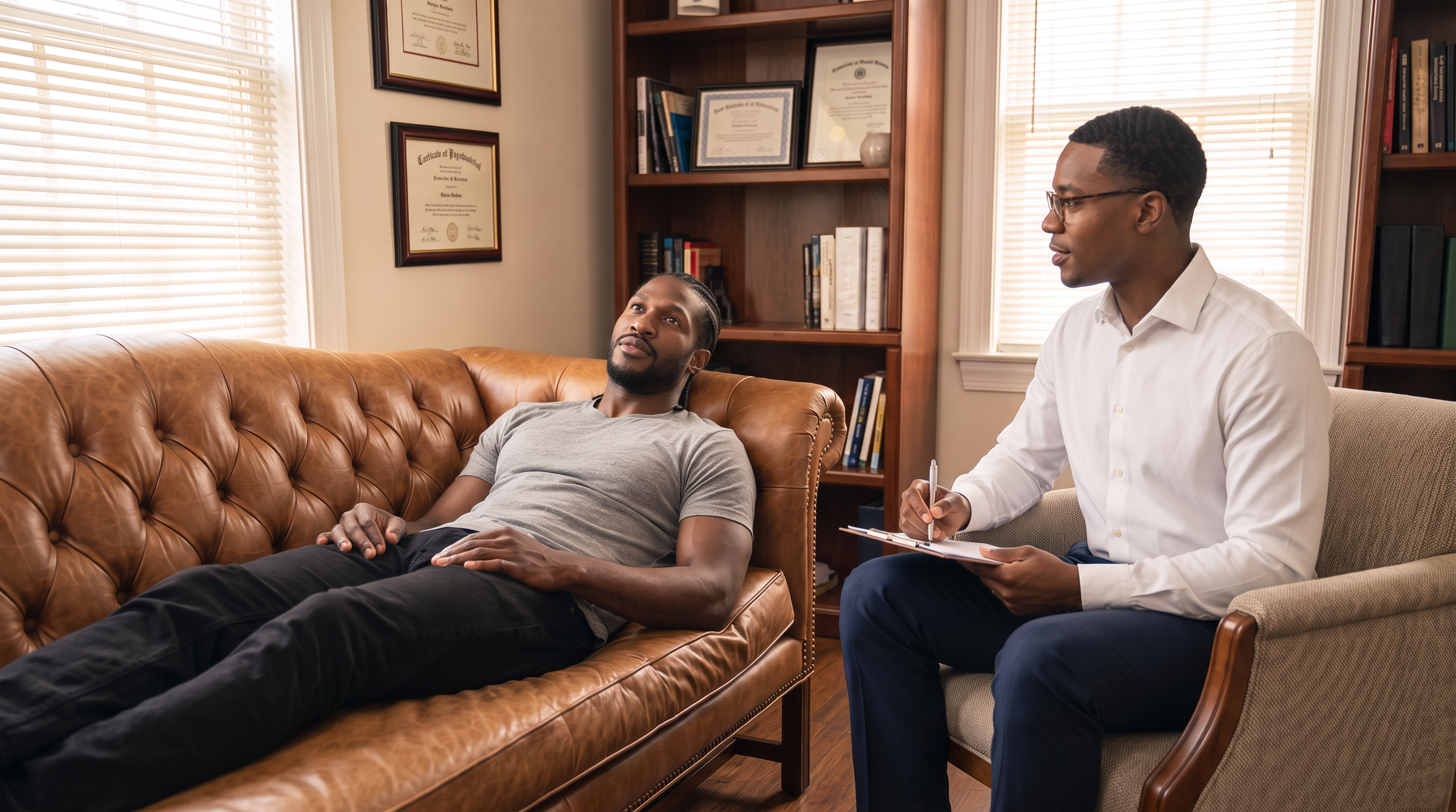
Dom of #SpiritandDom, sits across from a therapist during a session, illustrating the SlowBurnLove.com article "Conditioned Oppression: Why Won't Black Men Go to Therapy, the Cost of Always Being Strong”
Somewhere scrolling during this week’s conversations about Black love I heard a term from a video post talking about “conditioned oppression”. It is the idea that Black people often cannot see the oppression they live in because they have been in it so long it feels normal. It’s worse when the people leading our communities, the voices we trust and quote and follow, are the ones reinforcing it. It’s not always on purpose, but sometimes it’s just the water everyone is swimming in.
That concept of conditioned oppression stayed with me as I navigated this past week in this current politically heated environment.
Conditioned Oppression, Up Close
Conditioned oppression is not just about systems outside of our community. It is about the ideas we absorb from inside the Black community and repeat as truth. A political leader, a pastor, an influencer, an uncle at the cookout, can hand down a belief that keeps people small, and because it comes from someone who looks like us and speaks our language, we rarely question it. We just carry it forward. That is what makes it so hard to spot. Oppression from the outside is easy to name. Oppression that has been repackaged as tradition, as toughness, as "just how we do things," is much harder to see, let alone challenge or change.
This is why we need to start paying closer attention to who we let speak into our understanding of Black love.
I Stopped Following the Negativity
This week I made an intentional decision to unfollow the Black relationship pages that make their living off of rage bait and tearing us down. The ones that build content around every worst stereotype about Black men and Black women and dress it up as commentary. I used to tell myself I was following them to push back in the comments, to fight the narrative from the inside. But I was not fighting anything. I was feeding the algorithm the same engagement it wanted, and giving my attention to content that profits from our dysfunction.
Going forward, I am putting that energy toward pages that are actually trying to build something positive. One of my favorites is Dorian tha BeardedMan. He has the classic trope of silver fox, bearded zaddie aesthetic working for him, no doubt. This week he made a post about pushing back on normalizing micro cheating. He challenged the notion that staying in a long relationship isn’t always a flex rather than just a commitment two people chose that could also possibly be a toxic connection. His post aren’t always framed as Black issues specifically, but these patterns show up heavily in our community, and because he is a Black man saying it, his voice matters. It carries more weight where it is needed most.
Black Men and Backing Out of Therapy
A post in a Black men's health group I follow asked a simple question this week. Why aren't Black men in therapy? Their answers told a story on their own. Some said the gym is their therapy. Another stated fixing on their cars was the best way to deal with their emotions. Others said they put their families first and their own mental health second. Some said talking to a stranger felt pointless. Many said it was not worth the money. And more than one person brought up intergenerational trauma, weighing it against cognitive therapy – mentioning it as if one should know the difference between a cold and the flu.
Reading through it, I realized most of these men are not choosing badly on purpose. Nobody explained to them that intergenerational trauma and cognitive therapy are not competing ideas. Intergenerational trauma often describes where the wound came from. Therapy, including cognitive approaches, is one of the tools for treating it. If a man does not know that distinction, of course therapy can feel like it failed him. He never had the information to know what he was actually looking for.
I believe trauma lives in the body, not just the memory. It gets passed down through generations the same way features and mannerisms do. It may be part of why Black people move through rhythm and dance the way we do, releasing pinned up energy the body has been holding onto for longer than any one lifetime. It may be part of why Black sexuality is so often read as intense, as if something ancestral is being released, not just performed. I cannot prove that without a study or scientific proof. But I believe the body remembers what the mind buries, and Black bodies have been asked to bury a lot.
Whatever the full explanation is, Black people carry trauma differently than most, and it deserves real examination. It should start with Black men, our leaders of the culture, because no one has ever built them the room to fall apart safely.
Five Things a Black Man Can Do to Find the Help He Needs
Get specific about what he is dealing with then name it as anxiety, grief, anger, or trauma.
Look for a therapist who lists cultural competency or works specifically with Black clients, not just anyone with an open slot.
Try a consultation call first. Most therapists offer one, and it is the fastest way to tell if the chemistry is right.
Ask about sliding scale fees or community mental health clinics if cost is the barrier, instead of assuming therapy is out of reach entirely.
Treat the first therapist as a starting point, not a verdict. If it does not fit, that is data, not proof that therapy does not work.
Five Things a Black Woman Can Do to Help Him Get There
Bring it up without cornering him. A calm, private conversation is better than one that feels like an ambush or an ultimatum.
Share resources instead of demands. A name, a directory, a number to call removes the ability to make excuses.
Normalize it by talking about your own therapy or healing work openly, so it does not feel like something only broken people do.
Give him room to process without needing an immediate outcome. Sometimes support looks like patience, not pressure.
Hold the line on your own boundaries while you support him. Helping him heal should never require abandoning your own.