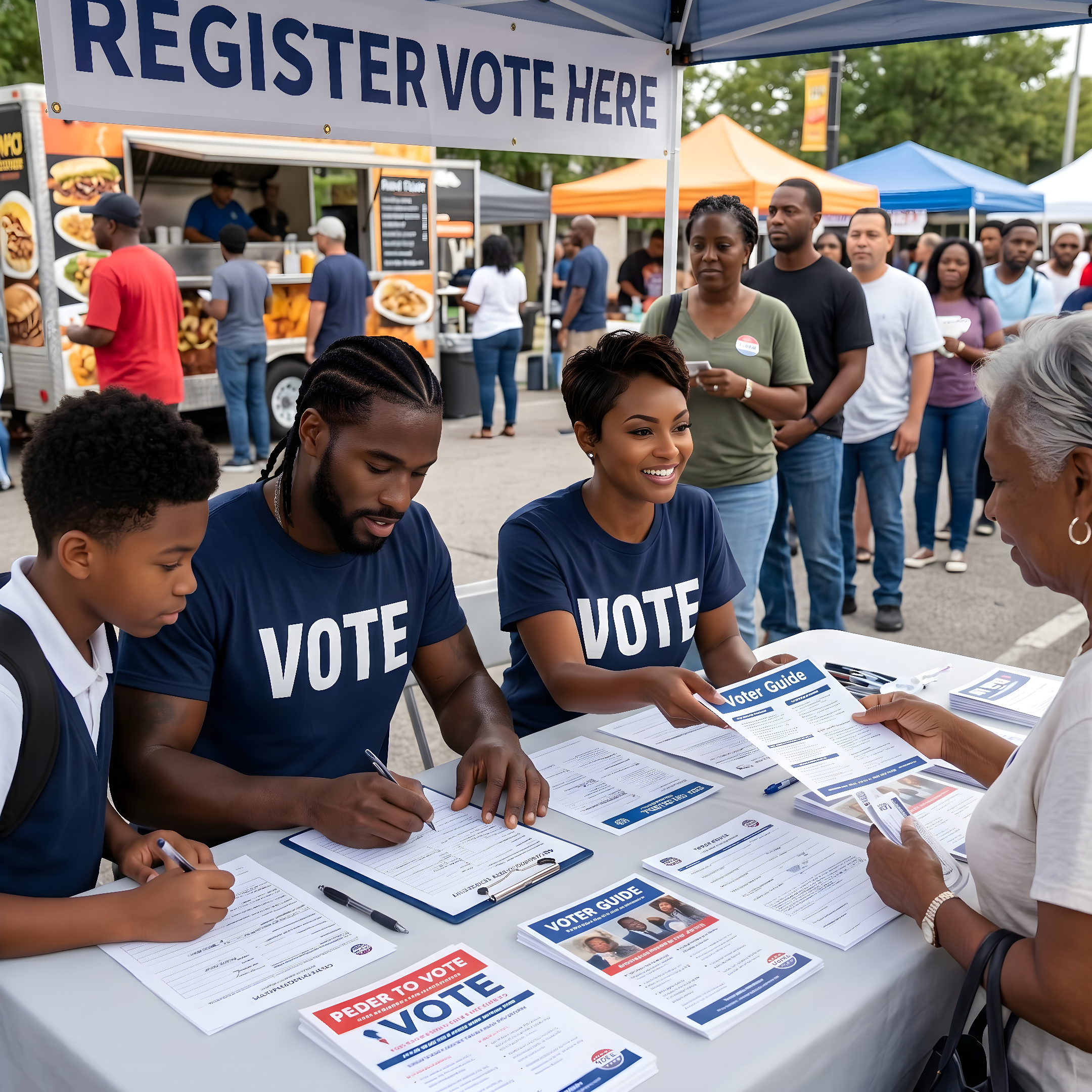
From slowburnlove.com WHY BLACK UNITY IS THE MOST RADICAL THING WE CAN DO RIGHT NOW. Black unity has never been more urgent or more powerful than it is right now. At a time when Black communities are being targeted politically, economically, and socially, choosing to organize, vote, and show up together is not just activism. It is survival. In this piece, we explore why collective action in Black communities, from voter registration to community organizing, is the most radical and necessary act of love we can offer each other and the next generation watching us do it.
Last week, the Supreme Court handed down a decision that should have stopped all of us in our tracks. In a 6-3 ruling, the Court's conservative majority all but ended the Voting Rights Act's guarantee that communities of color have the right to fair congressional districts where they can elect a candidate of their choice. Justice Elena Kagan, writing in dissent, warned that plaintiffs alleging schemes to dilute the representation of minority voters will now find it nearly impossible to succeed in court. Senator Raphael Warnock called it "yet another assault on voting rights." Senator Cory Booker called it "a further disenfranchisement of voters."
We should be outraged. But we also need to be clear-eyed about what is really happening, because this ruling did not happen in isolation. And if we only look at it as a legal story, we will miss the bigger picture entirely.
Know Who Is At The Table
His name is Kevin Roberts. He is 51 years old, and he is the head of the Heritage Foundation, the conservative think tank best known as the architect of Project 2025. Before he became one of the most powerful forces reshaping American politics, Roberts was a graduate student writing his thesis on the history of enslaved Black families in Virginia. His research explored what he called "the prevalence of the extended family" among enslaved African Americans and argued that the extended family group was perhaps the most important institution of cultural transfer and preservation in Black life under slavery.
Read that again slowly.
This man spent years studying how Black family bonds, how our love for each other, how our deep kinship networks were the very thing that kept us alive and sane under the most brutal conditions in American history. He understood our strength intimately. And now he leads the organization most responsible for dismantling Black political power at every level of American life.
That is not a coincidence. That is a blueprint.
The Algorithm Is Not Neutral
Now open your phone. Scroll through social media for fifteen minutes and count how many videos you see of Black men tearing down Black women. Count how many posts frame Black women as difficult, undesirable, or the reason for the problems in our community. Then count how many posts do the reverse. The content is everywhere, and it is relentless.
This is not organic. Platforms are designed to reward outrage and division because conflict drives clicks, and clicks drive profit. But the downstream effect of that business model is that Black people, specifically, are being fed a daily diet of content engineered to make us distrust and resent each other. The people who benefit most from our internal division are the same people who just finished redrawing our congressional districts to silence our votes. These are not separate conversations. They are the same conversation.
When we fight each other online, we are doing someone else's work for free.
What Black Men Can Do
• Audit your feed. If a video's entire purpose is to humiliate or degrade Black women, ask yourself who made it, who profits from your engagement, and what you are participating in when you hit share.
• Show up civically. Voter registration drives, redistricting advocacy, and local elections matter more than ever now that the courts are offering us less protection. Your presence is not optional.
• Be a vocal, public defender of Black women. Not because they need saving, but because speaking up is what men who understand this moment do.
• Call out the content directly. Challenge the narrative when you see it, in the comments, in the group chat, and in person. Make it clear you are not participating.
• Remember who built this community. Black women have been holding this community together for generations without enough credit. Recognizing that publicly and consistently is one of the most powerful things you can do right now.
What Black Women Can Do
• Your labor has always been the foundation. Black women have been the backbone of political organizing, community building, and cultural preservation in this country. That work is seen and valued here, even when the rest of the world refuses to acknowledge it.
• Do not feed the algorithm. Resist the urge to engage with bait content, even when it makes your blood boil. Engagement, including the angry kind, rewards the people who created it. Your energy is too valuable to be extracted that way.
• Build visible coalition with Black men who are doing the work. Seek them out, stand beside them, and make that partnership visible. It disrupts the narrative being pushed on our community every single day.
• Celebrate solidarity loudly and publicly. When people see Black men and Black women building together, laughing together, and organizing together in digital spaces, it counters the division being manufactured for profit.
• Keep leading. This community has always needed Black women at the front, and that is not changing now. The setbacks are real, but so is your power. Do not let anyone convince you otherwise.
What We Do Together
Here is what the Supreme Court's ruling really means in practical terms. The legal mechanisms that once protected minority voting districts are being stripped away. States like Florida moved to redraw congressional maps within hours of the ruling coming down. Republican-controlled legislatures in Arkansas, Missouri, Mississippi, Louisiana, and South Carolina are already discussing how this decision applies to their maps. The lines are being redrawn as you read this.
That means the courts are less available to us than they were last week. Which means we have to be more available to each other. Our political power has always lived in our unity, not in the goodwill of institutions that were never fully designed with us in mind. The ballot, the community organization, the local school board meeting, the relationship between the Black man and the Black woman sitting across the table from each other, all of it is connected. It always has been.
Kevin Roberts spent his academic career studying enslaved Black people who, with no legal rights, no freedom of movement, and no protection from the state, still managed to build extended family networks so powerful that they became the primary vehicle for cultural survival across generations. Those ancestors did not have the Voting Rights Act. They did not have social media. They had each other.
Black love is a slow burn, it is not passive. It is the daily, deliberate choice to protect what we have. It is choosing not to click the video designed to make you hate your own people. It is registering your neighbor to vote. It is showing up to the city council meeting. It is calling your person and telling them you see what is happening and you are not going anywhere.
They studied our bonds so they could break them. The most radical thing we can do right now is refuse to let that happen.
Until next time, Melissa Slow Burn Love
Disclaimer: The content on Slow Burn Love is for informational and educational purposes only and does not substitute for professional medical advice, diagnosis, or treatment. Always seek the advice of a physician or qualified mental health provider with any questions you may have regarding a medical or psychological condition. If you are in a crisis, please reach out to a local emergency service or a crisis hotline immediately.