
UNMASKING VULNERABILITY: RECLAIMING EMOTIONAL DEPTH IN BLACK ROMANCE
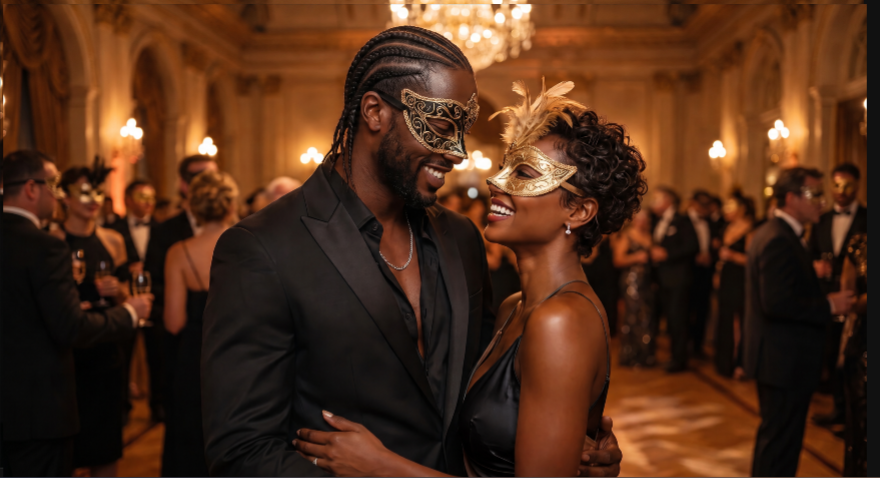
Behind the mask, we should be allowed to be seen, adored, and celebrated as our full selves. From slowburnlove.com UNMASKING VULNERABILITY: RECLAIMING EMOTIONAL DEPTH IN BLACK ROMANCE
Between October 11th and 17th, the NAACP and Advancement Project filed suit to stop the Justice Department from deploying federal law enforcement to polling sites as election monitors. Students from North Carolina A&T, UNC Greensboro, and Bennett College marched to a polling location after the campus sites were removed. Organizers announced National Black Man Voter Day for October 24th, with a Week of Action starting October 19th and a goal of reaching 100,000 Black men.
In Atlanta, Black renters make up roughly 70 percent of eviction cases in five metro counties while being about 52 percent of renters. Students at Southern University are trying to study through repeated power outages. And the Census Bureau is taking comments through November 2nd on a proposal that would remove race and ethnicity questions from the census.
Data is how we prove discrimination exists.
Our votes, homes, schools, and data are all being pressed on at once. When we’re dealing with this much stress outside, it’s bound to make it more challenging to love each other well on the inside.
The perm narrative
Then came the Vogue piece circulating this week, suggesting Black women are ready to go back to perms. I will say this plainly. We are not rushing back to something that harmed us.
A Boston University study followed nearly 45,000 Black women for up to 22 years. Among postmenopausal women, the most frequent relaxer users had more than a 50 percent higher risk of uterine cancer. The FDA had even considered banning some of the chemicals involved. We know of the harm that is in those jars.
No woman should be shamed for the type of hair she is born with. And a major publication packaging this as a collective return, while showing a photo of a Black woman wearing her natural hair wild and free, is not neutral. It is harm in itself. Algorithms reward whatever gets us arguing, and Black women debating our hair is great for engagement. Our health is the cost. When glossy pages and feeds repeat a story often enough, it starts to feel like our own idea. It is not. I refuse to let a narrative built for clicks walk us backward into something that hurt us.
Retrograde season and struggle love
For those of you that follow astrology, the planet Venus has been in retrograde since October 3rd. Mercury joins as retrograde also on October 24th, and both turn direct on November 13th. Whatever you believe about the sky, the Divine and God, retrogrades urge us to take a review of our lives. They bring old patterns back to the table to be audited, and one of the oldest in the Black community that is up for audit is struggle love.
Someone shared that when they first watched Whitley and Dwayne on A Different World as a young person back in the 90s, the takeaway was that love is supposed to be a fight. As I have been rewatching the old episodes I ask, was Whitley and Dwayne’s relationship dynamic struggle love or just two very young and stubborn people learning to adjust to one another?
Adjustment is healthy. Learning someone's rhythm, softening, and compromising is the work of every real relationship. It however becomes struggle when you do not evolve from it. If you are staying in a relationship where no one is growing, maturing and pain is the result of your proof of love, that is the struggle. Growth is the test. If you are both getting better, that is a slow burn. If you are only getting tired, giving too much and losing yourself, that is a warning.
What made us act strong instead of soft towards each other?
History taught us that needing anything came with a price. A Black man who could not pull himself up by his bootstraps was called weak, even when the system was built to work against him. A Black woman who spoke up was called angry, even when her anger was completely legitimate. So many of us learned to hide our needs and our feelings. And for many of us, the rules that did not allow us to express what we felt were like survival.
But we kept them long after the danger changed shape, and now we enforce those emotionally repressive rules on each other. We tell our daughters to put their big girl panties on and our sons that crying is weak. The pressure began outside of us, but we have been passing it down inside our own homes, generation after generation.
Breaking that cycle would be emotional sovereignty - letting go of the unspoken rules about how Black women and men must perform strength in relationships, and choosing instead to be soft, vulnerable, and cherished. It means stepping out of the collective expectation that love has to cost us our peace, and moving into partnerships that are equal, transformative, and liberating.
That kind of love grows through creative self-expression and building internal wealth, so you stop shrinking to fit someone else. It asks you to feel worthy of love that honors your full presence and not your performance. It lets you celebrate Black joy and royal self-worth, and to be seen, adored, and celebrated without downplaying your magic. It also requires durable boundaries and choosing long-term alignment over quick drama. That is the slow burn, building trust and safety with emotional maturity instead of reactive patterns.
5 ways Black men can lead toward the Black women they love
• Go first with honesty. Say what you feel, fear, and need before she has to decode you.
• Make her softness safe. When she lowers her guard, protect that moment and never use it against her in a later argument.
• Cherish out loud. Name what you adore about her in public and in private, without waiting for an occasion.
• Do your own healing. Use therapy, honest brothers, prayer, or whatever works, so she is not parenting your unhealed places.
• Share the load. Carry the planning, the emotional labor, and the follow through so she is not the only strong one in the house.
5 ways Black women can lead toward the men they love
• Let him see the unguarded you. Tell him when you are tired, scared, or need to be held instead of handling everything alone.
• Receive without auditing. When he gives care, let it land before you test it for flaws.
• Make room for his softness. Meet his tears or fear with tenderness, not disappointment.
• Hold your boundaries with love. Say what you will and will not accept, then follow through without punishing him for learning.
• Ask clearly for what you want. Do not make him pass an unspoken test. Be as direct as you expect him to be.
Where to go from here
This week asked a lot of us in public. Let love be the place where we exhale in private. Keep fighting for the ballot, the census, the roof over our heads, and the lights in our classrooms. But do not carry that fight into the bedroom, the kitchen, or the group chat as if love has to be another battle.
During this Venus and Mercury retrograde, review what you have been calling love. Keep the parts where you both grow. Release the parts where you only survive. And do not let any magazine, feed, or algorithm tell you who you are supposed to be or what you are willing to return to.
We were never meant to perform our way into being loved. We deserve to be known and cherished, slowly and with purpose.
Until next time,
Melissa Pozio
Slow Burn Love
Disclaimer: The content on Slow Burn Love is for informational and educational purposes only and does not substitute for professional medical advice, diagnosis, or treatment. Always seek the advice of a physician or qualified mental health provider with any questions you may have regarding a medical or psychological condition. If you are in a crisis, please reach out to a local emergency service or a crisis hotline immediately.